
Blog
Bathroom floor thresholds: what they are and why they matter

Apr
TL;DR:
- Bathroom thresholds protect floors from water damage, provide safe, neat transitions, and comply with regulations.
- Proper selection depends on floor height, moisture exposure, and accessibility requirements, with materials like metal or PVC.
- Correct installation and maintenance ensure durability, avoiding costly repairs and enhancing property value.
Most homeowners treat a bathroom floor threshold as the last item on the renovation list, something to grab quickly once the tiles are down and the grouting is dry. That instinct is understandable, but it leads to costly mistakes. A poorly chosen or missing threshold can allow water to creep under adjoining flooring, create a trip hazard for elderly family members, or leave an unsightly gap that undermines an otherwise immaculate bathroom. This article explains exactly what a bathroom floor threshold is, why it matters far more than people realise, which types suit different situations, and how to install and maintain one correctly.
Table of Contents
- What is a bathroom floor threshold?
- Types of bathroom floor thresholds and their key features
- Building regulations and accessibility: what the rules say
- Dealing with uneven floors: construction tips and best practices
- Installation and maintenance: ensuring durability and effectiveness
- Why bathroom floor thresholds are the unsung heroes of renovation
- Find the perfect bathroom floor threshold for your project
- Frequently asked questions
Key Takeaways
| Point | Details |
|---|---|
| Thresholds prevent water damage | Bathroom thresholds keep water contained, stopping expensive damage between rooms. |
| Types suit different needs | Choose the right threshold type to match both your floor style and the wetness of your bathroom. |
| UK rules protect accessibility | Install thresholds with a low upstand for easy access, especially in compliance with Part M regulations. |
| Solutions for uneven floors | Adjustable threshold bars and seals can bridge awkward gaps and deliver a clean finish. |
What is a bathroom floor threshold?
A bathroom floor threshold is a strip or bar that bridges the gap between your bathroom flooring and the flooring in the adjoining room or hallway. Think of it as a junction point: two different floor surfaces meet, and without a threshold, you are left with a raw edge, an expansion gap, or a height difference that looks unfinished and performs poorly.
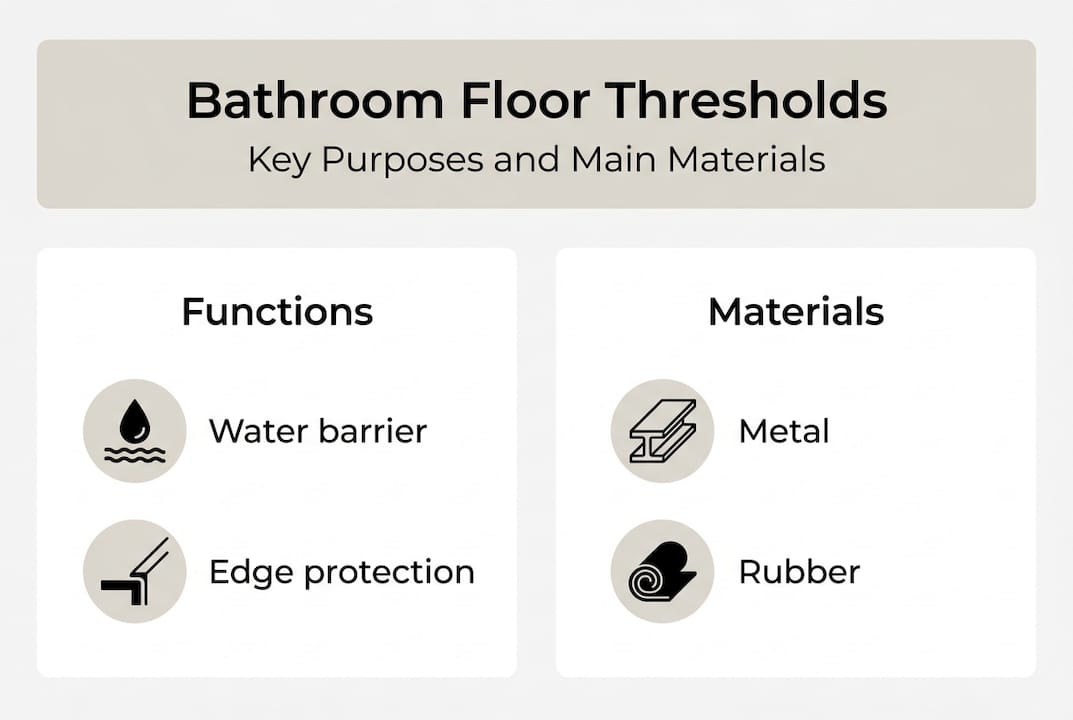
Thresholds serve several functions at once. They protect the subfloor and the edges of both floor coverings from moisture, foot traffic, and general wear. They conceal expansion gaps that flooring materials need to accommodate seasonal movement. They create a smooth visual boundary between contrasting surfaces, such as bathroom tile meeting hallway carpet or vinyl meeting laminate. As LABC guidance confirms, thresholds are functional in wet environments and key to transitions between different rooms.
For a broader understanding of how these products work across the home, our floor threshold guide covers the full picture, and our door threshold explained article addresses the specific challenges at doorways.
Here are the top four reasons every bathroom needs a properly fitted threshold:
- Water protection: Stops moisture migrating from wet surfaces into adjoining flooring, preventing rot, mould, and subfloor damage.
- Neat transition: Covers raw flooring edges and expansion gaps for a clean, professional finish that adds to the overall look of the room.
- Safety: Eliminates trip hazards created by height differences between floor surfaces, which matters especially for children and older adults.
- Regulation compliance: Ensures the installation meets UK building standards, particularly for accessible bathrooms where upstand heights are controlled.
Common threshold materials include solid metal, PVC, rubber, and wood. Each has its place, but in wet environments, material choice is critical. Solid metal bars, particularly those with a quality hand finish, offer the best combination of durability, hygiene, and visual appeal for bathroom use.
Types of bathroom floor thresholds and their key features
Not all thresholds are created equal, and choosing the wrong type for a bathroom can cause problems that are expensive to fix later. The most common types used in UK bathrooms are solid bar thresholds, T-bar profiles, water stops, and flexible profiles.
Solid bar thresholds sit flat across the transition point and are fixed directly to the subfloor. They suit most standard bathroom doorways where there is a modest height difference between the two floor surfaces. They are robust, easy to clean, and available in a range of finishes to match bathroom hardware.
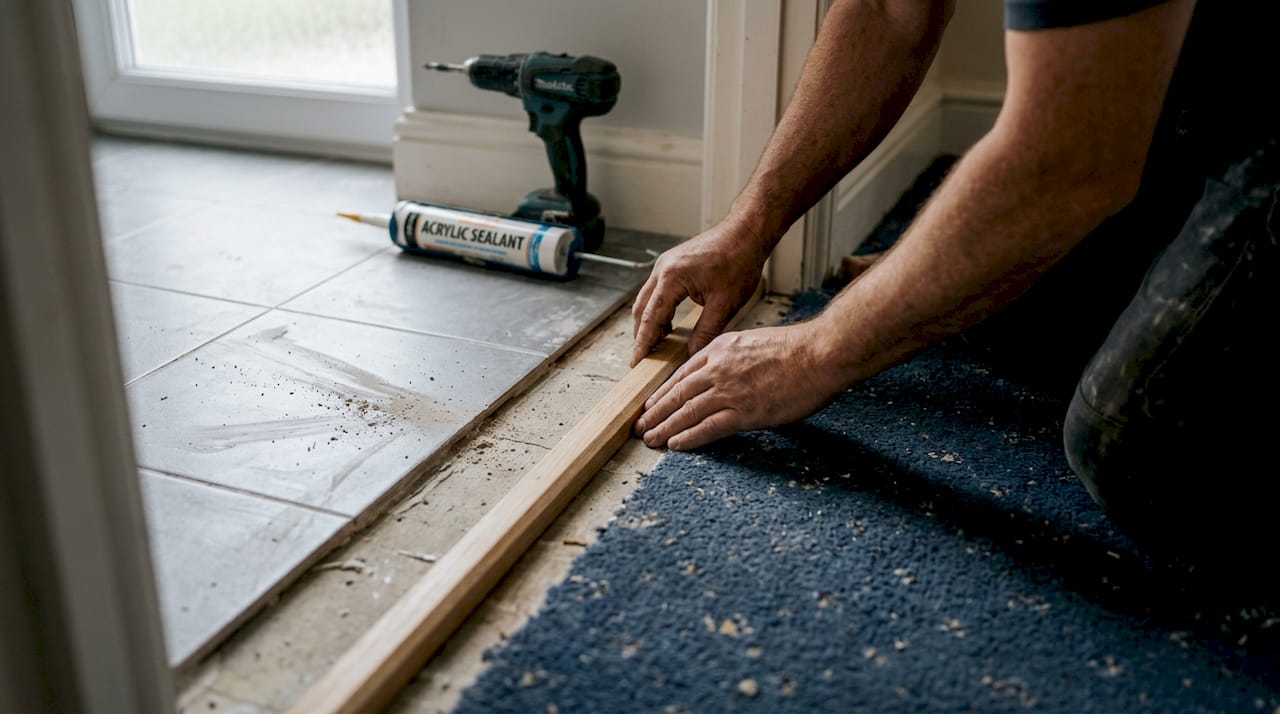
T-bar profiles are used when two floor surfaces of equal height meet. The T-shape sits centrally over the gap, holding both edges in place. These are popular for tile-to-tile or tile-to-vinyl transitions within open-plan bathroom and bedroom layouts.
Water stops are low-profile barriers designed specifically for wet rooms and shower enclosures. Their primary job is to retain water within the wet zone while still allowing drainage to fall correctly toward the drain. Low-profile PVC water stops are ideal in wet rooms and showers to stop water escaping while supporting drainage falls.
Pro Tip: Never underestimate water stops. A missing or poorly fitted water stop in a wet room can result in water damage to adjoining rooms, structural timber, and even the ceiling below. The cost of replacement runs into thousands. A quality threshold costs a fraction of that.
| Threshold type | Best use case | Key advantage | Watch out for |
|---|---|---|---|
| Solid bar | Standard bathroom doorway | Durable, smart finish | Ensure correct height match |
| T-bar profile | Equal-height floor transitions | Holds both edges securely | Not suitable for height differences |
| Water stop | Wet rooms and shower zones | Retains water, supports drainage | Must align with floor fall |
| Flexible profile | Uneven or curved transitions | Adapts to surface irregularities | Less durable long-term |
For transitions from bathroom tile to carpet in adjoining rooms, our carpet to laminate threshold range offers smart solutions. Where carpet meets carpet across a doorway, carpet to carpet thresholds provide a clean, secure join.
Building regulations and accessibility: what the rules say
Understanding your options is only half the task. In the UK, bathroom thresholds must also comply with building regulations, particularly where accessibility is concerned. Part M of the Building Regulations sets out requirements for accessible and adaptable dwellings, and thresholds are directly affected.
The key rule most homeowners and contractors overlook is the upstand height limit. Part M accessibility regulations specify a maximum 15mm upstand for accessible bathrooms. This means the threshold must not rise more than 15mm above the finished floor level. Anything higher creates a barrier for wheelchair users, people with mobility aids, and older residents.
“Accessibility requires low lips or gentle slopes with a maximum 15mm upstand.” This is not a guideline. For new builds and significant renovations, it is a legal requirement.
Here is a summary of the key regulatory considerations:
| Regulation area | Requirement | Notes |
|---|---|---|
| Maximum upstand height | 15mm | Applies to accessible bathrooms under Part M |
| Recommended profile | Low-profile or ramped | Gradual slopes preferred over abrupt steps |
| Water resistance | Required in wet zones | Threshold must prevent water egress |
| Material durability | Long-term performance | Must withstand moisture and cleaning products |
To ensure your installation is fully compliant, follow these steps:
- Check whether your project falls under Part M requirements by consulting your local authority or building control officer.
- Measure the finished floor height on both sides of the threshold position before purchasing any product.
- Select a threshold profile that keeps the upstand at or below 15mm.
- Confirm the product is suitable for wet environments if the bathroom includes a shower or wet room.
- Document your threshold specification as part of the overall building control submission if required.
For further guidance on UK floor threshold regulations and how they apply to doorways, our door threshold regulations resource is worth reading alongside the LABC bathroom guidance.
Dealing with uneven floors: construction tips and best practices
Uneven floors are one of the most common challenges in bathroom renovation, particularly in older UK properties where subfloors have settled, timber has warped, or previous tiling has created an inconsistent surface. A threshold that works perfectly on a level floor can rock, gap, or fail to seal properly on an uneven one.
Threshold bars with a 5mm raise and adjustable seals are effective for bridging uneven gaps beneath bathroom doors or between surfaces. The adjustable seal element is important: it allows the threshold to maintain contact with the floor even where the surface dips or rises slightly.
Pro Tip: Before purchasing any threshold, lay a spirit level across the gap and measure the maximum height variation. If the variation exceeds 5mm, look specifically for products with adjustable or flexible base components. Buying a fixed-height bar for an uneven floor is one of the most common and avoidable installation errors.
Here is a practical approach to fitting a threshold on an uneven floor:
- Clean the subfloor thoroughly and remove any adhesive residue or debris.
- Measure the gap width and the height variation across the full length of the threshold position.
- Select a threshold with an adjustable or flexible underside to accommodate the variation.
- Use a self-levelling compound to fill low spots if the variation exceeds what the threshold can accommodate.
- Fix the threshold using the manufacturer’s recommended method, whether adhesive, screws, or a combination.
- Check the threshold is stable and does not rock before sealing the edges.
Common mistakes to avoid when dealing with uneven floors:
- Forcing a rigid bar onto an uneven surface: This creates stress points that cause cracking or lifting over time.
- Skipping the self-levelling compound: Small gaps beneath the threshold allow water to travel underneath.
- Over-tightening screws on a flexible profile: This distorts the bar and creates new gaps at the edges.
- Ignoring the drainage fall: In wet rooms, the floor must slope toward the drain. A threshold must not interrupt this fall.
For projects involving significant height differences, our transition strips for uneven floors range offers purpose-built solutions. Our flooring thresholds best practices guide covers the wider principles in detail.
Installation and maintenance: ensuring durability and effectiveness
Even the best threshold performs poorly if fitted incorrectly. Whether you are a DIY enthusiast tackling your first bathroom renovation or a contractor fitting dozens of thresholds a year, the installation process follows the same core principles.
Tools and materials you will need: tape measure, pencil, hacksaw or metal cutter, spirit level, appropriate adhesive or screws, sealant, and a clean cloth.
Follow these steps for a reliable installation:
- Measure carefully. Measure the width of the doorway or transition point twice. Mark the threshold bar to length before cutting.
- Cut cleanly. Use a fine-tooth hacksaw for solid metal bars. Deburr the cut edge with a file to prevent sharp edges.
- Prepare the subfloor. Ensure the surface is clean, dry, and level within the tolerance of your chosen threshold.
- Fix the threshold. Use the fixing method appropriate to your floor type. Screw-fixed bars are more secure on timber subfloors. Adhesive fixing suits concrete or tile.
- Seal the edges sparingly. Seal at threshold edges in wet zones and always allow for drainage falls. Do not seal so heavily that you block the drainage path.
- Check and test. Press along the full length of the threshold to confirm it is secure. Pour a small amount of water near the edge to confirm the seal is effective.
For long-term maintenance, inspect the threshold every six months. Look for signs of sealant shrinkage, lifting edges, or discolouration around the base. Clean with a damp cloth and a mild, non-abrasive cleaner. Avoid bleach-based products on metal finishes as they can damage the surface over time. A well-maintained threshold fitted correctly should last for many years without needing replacement. Our floor threshold installation guidance covers additional detail for specific floor types.
Why bathroom floor thresholds are the unsung heroes of renovation
Having worked through every practical consideration, it is worth stepping back and making a broader point. In our experience, the majority of bathroom leaks, trip hazards, and unsightly flooring transitions trace back to one decision made too late: the threshold was an afterthought.
Most renovation budgets plan for tiles, sanitaryware, and labour. Thresholds rarely appear on the initial specification. They get chosen in a rush at the end, often based on price alone. That is when problems start. A threshold chosen without considering water management, accessibility, or floor height compatibility will fail, and the cost of putting it right is always greater than the cost of getting it right first time.
There is also a subtler point about property value. Buyers and surveyors notice seamless transitions. A bathroom that flows neatly into a hallway, with a flush, well-finished threshold that looks like it belongs there, signals quality throughout. It is an invisible feature when done well, and a glaring problem when done poorly. The role of thresholds in creating a polished finish is something we feel strongly about, and it deserves the same planning attention as any other element of the room.
Find the perfect bathroom floor threshold for your project
Now that you understand exactly what bathroom floor thresholds do and how to choose the right one, the next step is finding a product that meets your specification. At Quality Carpet Trims, we supply solid metal door bars and thresholds, hand-finished in 10 beautiful finishes to complement any bathroom interior.

All our products are British-made, built to last, and designed to meet the practical demands of wet environments. Whether you need a sleek bar for a standard bathroom doorway or a specialist solution for a wet room transition, our threshold strips range has you covered. You can also explore our matwell flooring trim options and brush up on product terminology with our flooring trim terminology UK guide. Contact us directly for advice on large projects or bespoke requirements.
Frequently asked questions
What is the purpose of a bathroom floor threshold?
A bathroom floor threshold joins different floor surfaces, prevents water seeping between them, and creates a safe, neat transition. As LABC guidance confirms, thresholds serve essential functions including water resistance and safe transitions, especially in wet or high-traffic areas.
How high should a bathroom threshold be in the UK?
For accessible bathrooms, Part M regulations specify a maximum 15mm upstand above the finished floor level. Keeping within this limit ensures compliance and reduces trip hazards for all users.
What is the best threshold material for wet rooms?
Low-profile water stops are the recommended choice for wet rooms because they retain water within the wet zone while allowing the floor to drain correctly. LABC guidance specifically recommends low-profile solutions to support drainage falls in shower and wet room applications.
Can a threshold strip fix an uneven bathroom floor gap?
Yes. Threshold bars and adjustable seals are effective for bridging uneven gaps beneath bathroom doors or between surfaces, particularly when the variation is within the product’s adjustment range.
Recommended
- What is a floor threshold? A practical UK guide
- Understand the role of flooring thresholds for a perfect finish
- Home flooring thresholds: your guide to seamless finishes
- Why use door thresholds? Key benefits for UK homes
- Why Use Travertine in Bathrooms: Luxury Meets Functionality – Marmorique